Can AI Personalize Nutrition Without Overpromising?
Can AI personalize nutrition safely? Learn how data quality, privacy, uncertainty, and human oversight shape responsible nutrition guidance with MyFitLife.
Can AI personalize nutrition without overpromising? Yes, but only if personalization means helping a person make better decisions from relevant context. It should not mean pretending that a chatbot can determine exactly how someone will respond to every food, diagnose a condition, or replace a registered dietitian or physician. Responsible AI nutrition support is less about producing a perfect diet and more about turning messy daily information into practical, reviewable choices.
MyFitLife is designed for that general-wellness layer. Food logs, meal timing, hydration, goals, preferences, recipes, and progress can give an AI assistant more useful context than a generic question. At the same time, food database results, barcode data, meal-photo analysis, generated recipes, MyFit Score values, and AI responses are estimates. The right question is not whether AI can sound personalized. It is whether the recommendation is grounded in reliable information, transparent about uncertainty, and safe for the decision being made.
What does personalized nutrition actually mean?
Personalized nutrition can describe several different levels of support. At the simplest level, a system remembers preferences such as vegetarian meals, a limited cooking schedule, a food budget, or ingredients already in the pantry. A more adaptive system considers recent meals, hydration, activity, goals, and patterns over time. Research programs may also study biomarkers, genetics, microbiome data, or metabolic responses. These are different use cases with different evidence and safety requirements.
The NIH Nutrition for Precision Health program illustrates the research ambition: use large, diverse datasets and artificial intelligence to study how individuals respond differently to foods and dietary patterns. That work treats personalization as a scientific prediction problem that requires careful measurement and validation. It does not mean that every consumer nutrition app can infer a person's biology from a short chat or a single meal photo.
- Preference-aware support adapts to foods, schedules, budgets, cooking skills, and cultural habits.
- Context-aware support considers what has already been logged, what remains in the day, and which decision is coming next.
- Pattern-aware support looks across repeated entries instead of treating one meal as a definitive result.
- Clinical personalization uses medical information and validated workflows that require appropriate professional oversight.
Why more data does not automatically produce better guidance
An AI system can only reason from the information it receives. If a meal is missing its portion size, preparation method, brand, toppings, or beverage, the resulting nutrition estimate may be materially different from what was eaten. If a user logs only successful days, the system may see a cleaner routine than the one that actually needs support. More fields do not solve the problem when the underlying data is incomplete, inconsistent, or biased toward one type of user.
Recent nutrition-AI research identifies data quality, interpretability, validation, and causal inference as continuing challenges. A systematic review of AI-based dietary assessment methods also found that the evidence base remains uneven. In practical terms, an AI answer can be useful without being a measurement instrument. It should help organize decisions while leaving room to verify the inputs and question the output.
- Log the food as specifically as practical, including the serving size and preparation details that affect the estimate.
- Verify barcode, label, and photo-based suggestions before treating them as your actual meal record.
- Add context such as time, hunger, hydration, schedule pressure, or available ingredients when that context changes the decision.
- Compare repeated patterns across several days instead of reacting to one calorie, macro, or scale value.
- Correct the record when you learn that a portion, ingredient, or nutrition value was wrong.
How can AI make everyday nutrition planning more useful?
The most defensible use of AI in nutrition is decision support. It can summarize what has been logged, compare meal options, suggest recipes that fit stated constraints, turn planned meals into a grocery list, or help a user identify the next manageable action. These tasks are useful because the user can inspect the inputs, review the suggestions, and decide whether the result fits real life.
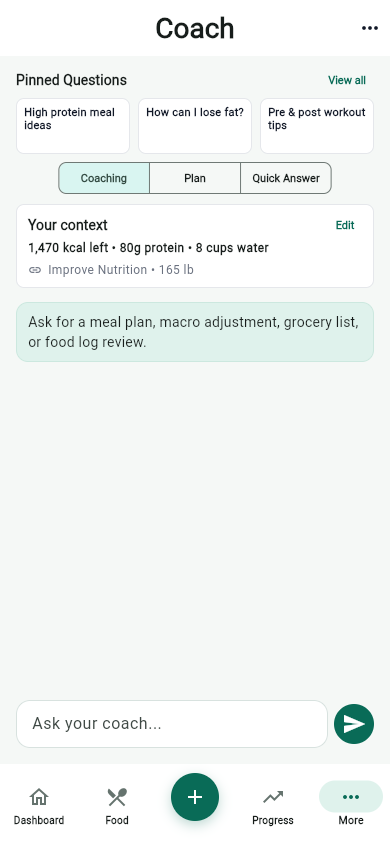
In MyFitLife, Coach Milo can work from the nutrition context already present in the app, including food records, calorie and protein targets, hydration, goals, and recent progress. Recipe AI can help turn ingredients, preferences, and a meal request into a starting point for a recipe. The user still needs to review ingredients, portions, allergens, and nutrition details before relying on the result.
- Ask Coach Milo to compare two meals against the targets you are already using.
- Ask for several options with explicit constraints such as time, budget, ingredients, or cooking equipment.
- Use Recipe AI to create a practical meal idea, then review and edit it before saving or shopping.
- Use your logs to identify a repeatable adjustment rather than asking AI for a universal rule.
The MyFitLife answer
MyFitLife answer is that AI can personalize the planning process without claiming to personalize medical care. The app should help you describe your routine, see the tradeoffs in front of you, and choose a next step that you can verify. It should not present an estimate as a fact or turn a general wellness suggestion into a diagnosis, treatment plan, medication instruction, or promise of a health outcome.
- Give the system a real decision: choose dinner, plan tomorrow breakfast, use available ingredients, or find a practical way to increase variety.
- State the constraints that matter: time, budget, preferences, equipment, foods to avoid, and the target you are trying to keep visible.
- Ask for options and tradeoffs rather than a single perfect answer.
- Review the output against the label, recipe, portion, and your own circumstances.
- Log what you actually did and use the result as feedback for the next decision.
Can AI know exactly what your body needs?
Not from ordinary food logging alone. Individual responses to food can be influenced by many factors, including portion, timing, activity, sleep, medications, health conditions, and biology. A research model that predicts a specific response must be tested on appropriate data and evaluated for accuracy, bias, generalizability, and clinical usefulness. A fluent AI response is not evidence that those requirements have been met.
MyFitLife does not diagnose, treat, cure, prevent, or monitor disease, and it should not be used as a glucose monitor or as a substitute for medical nutrition therapy. Users who track glucose or other health measurements elsewhere may use their food log as a discussion aid, but interpretation of medical readings belongs with the qualified professional managing that care.
Why privacy is part of personalization
Personalization depends on personal information, which makes privacy a design requirement rather than a footnote. Food patterns, weight history, goals, allergies, medication context, and health-related questions can be sensitive even when they are entered into an everyday wellness app. The FTC guidance for mobile health apps and its Health Breach Notification Rule show why organizations must be clear about how health-related information is collected, used, shared, secured, and handled after an incident.
Before using any AI nutrition feature, read the current privacy statement and provide only the context needed for the task. Avoid treating a chat as a private clinical consultation. Review permissions, understand what information is retained or shared, and use available account or support processes for data-management requests. Privacy details can change, so the product Privacy Statement is the source of truth for MyFitLife-specific practices.
- Prefer the minimum information needed to answer the question.
- Check that the food, portion, and preference details you provide are accurate enough for the decision.
- Do not assume that an AI response is confidential medical advice.
- Review the product privacy statement before connecting or importing additional health data.
- Use professional care for decisions that depend on diagnoses, medications, laboratory results, or prescribed nutrition plans.
When should a human professional take over?
AI can help prepare questions for a clinician, but it should not override an individualized care plan. Seek qualified guidance before making significant diet or medication-related changes if you have diabetes, kidney disease, food allergies, a history of an eating disorder, are pregnant or breastfeeding, take prescription medication, or follow a prescribed diet. The same boundary applies when a recommendation could affect symptoms, blood glucose, medication timing, or treatment.
Stop and seek professional help if an AI recommendation causes concern, worsens symptoms, encourages extreme restriction, or conflicts with instructions from your care team. MyFitLife is a general-wellness and planning tool. It is not emergency support, a medical device, or a replacement for a physician or registered dietitian.
How to judge an AI nutrition answer
- Grounding: Does the answer clearly use the information you supplied, or is it generic?
- Uncertainty: Does it acknowledge missing portions, unknown ingredients, or estimate limitations?
- Fit: Does the suggestion respect your schedule, budget, preferences, and actual food access?
- Tradeoffs: Does it show more than one reasonable option when the decision involves competing goals?
- Verification: Can you check the label, ingredients, portion, or source before acting?
- Safety: Does it stay within general wellness guidance and direct medical questions to a qualified professional?
Build a feedback loop instead of chasing a perfect plan
The most useful AI nutrition workflow is a loop: capture what happened, ask a focused question, review the answer, choose a manageable action, and record the result. Over time, that process can make your preferences and constraints easier to see without pretending that the app has discovered a permanent formula for your health.
That is the practical role for MyFitLife. Use food logging, hydration, progress, Pantry, Grocery, Coach Milo, Recipe AI, and MyFit Score to reduce decision friction and make patterns visible. Keep estimates reviewable, keep privacy choices understandable, and keep medical decisions with qualified professionals. AI can make nutrition support more relevant, but trust comes from useful context, honest limits, and a person who remains in control.
Sources and further reading
- Nutrition for Precision Health, powered by the All of Us Research Program NIH Common Fund
- Applying Artificial Intelligence and machine learning in precision nutrition Nature Communications
- Validity and accuracy of artificial intelligence-based dietary intake assessment methods: a systematic review British Journal of Nutrition via PubMed
- Artificial Intelligence Risk Management Framework (AI RMF 1.0) National Institute of Standards and Technology
- General Wellness: Policy for Low Risk Devices U.S. Food and Drug Administration
- How to Understand and Use the Nutrition Facts Label U.S. Food and Drug Administration
- FoodData Central U.S. Department of Agriculture
- Mobile Health App Interactive Tool Federal Trade Commission
- Complying with the FTC Health Breach Notification Rule Federal Trade Commission
- MyFitLife Privacy Statement MyFitLife
- MyFitLife Health Disclaimer MyFitLife
Related articles
- Can an AI Nutrition Coach Guide You to the Right App Screen Without Changing Your Data?
- AI Nutrition Coach Questions That Lead to Better Answers
- How to Get Better Answers From Coach Milo
Install free. Keep the core tracker free.
Log food, scan barcodes, track macros, and review progress without starting a subscription.