Why Am I Not Losing Weight in a Calorie Deficit—and What Should I Track Before Cutting More?
Review measurement integrity, consistency, trend horizon, and professional escalation before assuming a logged calorie deficit requires more restriction.
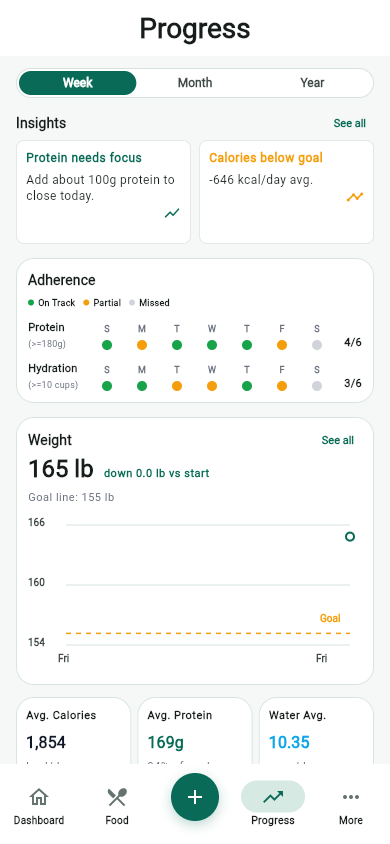
Why are you not losing weight in a calorie deficit? The first answer is that a calculated or logged deficit is an estimate, while a sustained body-weight trend is an observation influenced by intake, expenditure, measurement error, water, and time. Before cutting more, audit whether food and portions were captured accurately, whether the plan was followed often enough to evaluate, whether weigh-ins were compared consistently across a meaningful interval, and whether symptoms, medications, or health history require professional review. MyFitLife can organize that evidence; it cannot diagnose a plateau or prescribe a deeper deficit.
A flat scale is frustrating precisely because the explanation is rarely visible in one number. It may reflect ordinary short-term variability, incomplete logging, a plan that is hard to follow, an incorrect energy estimate, a changing activity routine, or a medical factor outside a consumer app’s scope. It can also be too early to distinguish signal from noise. The responsible response is not to assume failure or recommend automatic restriction. It is to establish what was measured, how consistently, for how long, and with what limitations.
A calorie deficit is a relationship, not an app setting
In energy-balance terms, a deficit means energy intake is lower than energy expenditure over a period. A target in an app is a plan derived from inputs and assumptions; it is not direct measurement of either side. Food labels, database values, restaurant portions, recipes, wearables, activity factors, and self-reported intake all contain uncertainty. Even an accurate basal estimate cannot observe every movement, adaptation, or change in routine. Selecting a calorie target therefore does not establish that the intended deficit occurred.
The NIDDK Body Weight Planner demonstrates another important point: weight change is dynamic. As body weight and behavior change, energy expenditure and the predicted trajectory can change rather than following a fixed calories-per-pound rule. Its limits reinforce the point: it is educational, not medical advice or a model for children, pregnancy, or breastfeeding. A straight-line expectation is too simple for a dynamic system.
Separate planned, logged, and observed data
Troubleshooting becomes clearer when three layers remain separate. Planned data include the calorie target, meal structure, and intended activity. Logged data include what the person entered: foods, portions, drinks, and check-ins. Observed data include body-weight measurements and other outcomes. A target can be reasonable while the log is incomplete. A log can be complete while serving estimates are inaccurate. A weight trend can be flat temporarily even when recent records reflect the plan.
- Plan question: What behavior was intended, and was it realistic for the person’s schedule, access, preferences, and professional guidance?
- Log question: Which foods, amounts, days, drinks, cooking ingredients, and events were actually recorded, and where is uncertainty concentrated?
- Observation question: Were measurements taken under comparable conditions, and what does the trend—not one reading—show?
- Interpretation question: Is the evidence strong enough to support a conclusion, or is more time, better data, or clinical context required?
Audit food identification before totals
Start upstream. A calorie total can look precise even when the selected foods do not match what was eaten. Barcode records may describe an old formulation or different package. Search results may represent raw rather than cooked food, a leaner cut, or a generic preparation. Photo estimates may miss oils and hidden ingredients. Saved meals may preserve a former portion. Compare repeat packaged foods with current labels, confirm preparation methods, and replace obviously mismatched database entries.
Do not focus only on high-calorie foods. A systematic error in a food eaten daily can matter more than a large but rare meal. At the same time, avoid using an audit to assign moral value to food or demand perfect capture. The purpose is to locate material uncertainty. USDA FoodData Central and current Nutrition Facts labels are useful evidence, but foods still vary and labels use standardized conventions. The goal is a more coherent estimate, not laboratory certainty.
Audit portions, units, and easily omitted energy
Portion error enters when a label serving is mistaken for the amount eaten, household measures are loosely filled, cooked and uncooked weights are confused, or an app defaults to an unfamiliar unit. For several representative days, verify repeat foods with a scale or an appropriate measuring tool when practical. Match grams to grams and milliliters to milliliters. Do not convert volume to weight without a relevant density, and update the log when the package changes its serving definition.
Review components that are easy to miss: cooking oil, butter, dressings, sauces, sweetened beverages, alcohol, creamers, bites while preparing food, toppings, and additions to a shared dish. This is not an accusation that an unlogged condiment explains every plateau. It is a data-integrity check. If a component is too difficult to estimate precisely, document a reasonable amount and retain the uncertainty rather than choosing zero because the value is inconvenient.
Measure completeness without demanding perfection
A weekly calorie average built from four complete days and three mostly blank days is not a seven-day intake estimate. Before interpreting the average, classify days by completeness. A complete day includes all meaningful foods and drinks to the best of the user’s knowledge. A partial day can still provide behavioral information, but it should not silently lower the average. Likewise, a streak of opening the app is not the same as a complete dietary record.
Systematic reviews report that digital self-monitoring can support behavioral weight-management interventions and that greater monitoring is often associated with weight loss. They do not prove that logging causes an outcome for every person. Use monitoring for awareness and structured review, not as a guarantee. If detailed tracking increases anxiety, rigidity, compensatory behavior, or eating-disorder symptoms, stop and seek appropriate professional support.
Distinguish adherence from the design of the plan
A plan can fail operationally without a person failing morally. Travel, caregiving, shift work, food cost, hunger, sleep disruption, stress, social events, and an overly demanding meal structure can make the intended routine hard to repeat. Compare planned behaviors with recorded behaviors neutrally. Did the plan fit weekdays but not weekends? Were meals skipped and followed by late eating? Was food logging abandoned on restaurant days? These are design signals that may call for a more workable plan, not necessarily fewer calories.
Also distinguish logging adherence from plan adherence. A person may follow a meal plan but enter it incompletely, or log accurately while intentionally choosing something else. Neither conclusion should be inferred from app activity alone. Ask what happened. If a registered dietitian or clinician created the plan, bring the discrepancies and trend back to that professional rather than independently tightening it.
Why one weigh-in cannot confirm the trend
Scale weight includes more than body fat. Food and fluid in the digestive tract, carbohydrate storage and its associated water, sodium intake, menstrual-cycle changes, inflammation after unfamiliar exercise, bowel patterns, clothing, scale placement, and measurement time can move a reading. These effects can temporarily mask or exaggerate a change in tissue. A short rise does not automatically mean fat gain, and a short drop does not prove that the plan is appropriate.
Use comparable measurement conditions if self-weighing is appropriate for you: the same scale, a stable surface, a similar time of day, and a consistent clothing routine. Then examine a rolling average or another clearly defined trend rather than comparing the highest and lowest individual points. Research on self-weighing evaluates it as part of behavioral interventions; it should not be presented as mandatory. For people whose mental health or treatment plan is harmed by weighing, clinician-directed alternatives take priority.
Use a trend horizon matched to the question
A day answers what the scale read that day. A week begins to show repetition but can still be dominated by water and schedule effects. Several consistently measured weeks provide a stronger behavioral and weight record, though there is no universal number of days that proves a plateau. The appropriate horizon depends on starting context, measurement frequency, magnitude of expected change, and clinical considerations. Avoid declaring success or failure from a convenient cutoff.
Consider a hypothetical four-week series of weekly average weights: 186.8, 187.2, 186.3, and 185.9 pounds. Selecting only the first two weeks suggests gain; selecting the highest day and lowest day could exaggerate change; the full averages suggest a modest downward direction with week-to-week noise. This is not a promised rate. It shows why the method and window should be chosen before interpreting the result.
The Before You Cut More four-gate framework
- Measurement integrity: Confirm food identity, serving basis, quantities, omitted items, day completeness, and comparable weigh-in conditions. Mark estimates rather than hiding uncertainty.
- Consistency: Compare the intended plan with what was actually practical across weekdays, weekends, travel, meals out, sleep disruption, and changes in activity. Look for a repeatable pattern, not perfect behavior.
- Trend horizon: Review predefined averages over enough consistently measured time to reduce the influence of isolated readings. Do not move the window until it produces the conclusion you expected.
- Professional escalation: Bring the record to a physician or registered dietitian when the trend remains unexplained, the proposed intake is restrictive, symptoms are present, medications or conditions may matter, or the tracking process is harming wellbeing.
A gate is not a command to proceed. Passing the first three only means the record is better organized; it does not authorize a deeper deficit. The next appropriate action may be maintaining the current approach longer, improving measurement, changing the structure of the plan without increasing restriction, taking a tracking break, or seeking individualized care. MyFitLife does not select among those medical or nutrition-treatment choices.
Use MyFitLife records alongside relevant outside context
Calories are not the only useful fields in a wellness record. Within MyFitLife, protein and meal composition describe the routine, while hydration entries show whether fluid logging is consistent. MyFitLife does not record daily sleep or workout sessions. If sleep, training, work demands, medication, illness, or another outside factor changed, consider it separately when preparing questions about hunger, recovery, and adherence. These signals are not automatic explanations for a plateau and should not be optimized in isolation from medical history and dietary adequacy.
Exercise calories deserve particular care. Consumer devices estimate energy expenditure, and automatically eating back every displayed calorie can change the intended plan. Conversely, ignoring a large increase in training may leave a person underfueled. Use one consistent approach developed with an appropriate professional when performance or health is at stake. Do not alternate methods depending on whether a number makes the day look more successful.
When not to make the plan more restrictive
Do not cut more because of a single weigh-in, a few incomplete logs, a target borrowed from another person, or pressure to meet a deadline. Do not use a consumer app to override a clinician’s plan. Restriction requires particular caution for minors; people who are pregnant or breastfeeding; people with diabetes, kidney disease, gastrointestinal disease, or medication considerations; athletes with high fueling demands; and anyone with current or previous disordered eating.
Seek medical evaluation for unexplained or rapid weight change, fainting, persistent dizziness, significant weakness, severe fatigue, swelling, dehydration concerns, menstrual changes, gastrointestinal symptoms, or other concerning symptoms. Medicines, health conditions, stress, hormones, age, and environment can affect weight management, as the CDC notes. A responsible app cannot determine which factor applies. If the proposed intake feels unsafe, unsustainable, or obsessive, that is a reason to pause—not a reason to push harder.
Build a review packet instead of a verdict
A useful review packet contains the target and who set it, several representative complete food days, notes about uncertain foods and restaurant meals, a summary of complete versus partial logging days, consistently collected weight averages, major schedule or activity changes, relevant symptoms, and a current medication or supplement list for a clinician. It avoids retroactively editing inconvenient days to make the plan look consistent. Missingness is information and should remain visible.
Bring questions rather than conclusions: Is the target appropriate for my history and current activity? Is my measurement method adequate for the decision? Could a medication or condition affect this trend? Would a less restrictive, more sustainable structure be safer? Which symptoms require evaluation? This transforms the app record from an attempted diagnosis into a more efficient conversation with someone qualified to diagnose and treat.
The MyFitLife answer
MyFitLife answers a stalled-deficit question by organizing the evidence before any decision to cut more. Use Food to review identities, labels, servings, portions, and complete days; use Dashboard and related wellness records to preserve context; and use Progress to compare consistently collected measurements over time. Then apply the four gates: measurement integrity, consistency, trend horizon, and professional escalation. The output is a clearer record and a better question—not a diagnosis or an automatic calorie reduction.
MyFitLife is a general-wellness iOS and Android app, not a medical device or weight-loss treatment. It does not verify an energy deficit, prescribe calorie targets, explain a plateau, or promise an outcome. A logged estimate can support self-awareness, and a trend can support review, but individualized decisions belong with a qualified healthcare professional who can evaluate the person, medical history, medications, symptoms, and complete context. Before cutting more, improve the evidence and protect safety; sometimes the most technically sound next step is not more restriction at all.
Sources and further reading
- About the Body Weight Planner National Institute of Diabetes and Digestive and Kidney Diseases
- Weight Management and Healthy Living Tips National Institute of Diabetes and Digestive and Kidney Diseases
- Steps for Losing Weight Centers for Disease Control and Prevention
- How to Understand and Use the Nutrition Facts Label U.S. Food and Drug Administration
- Serving Size on the Nutrition Facts Label U.S. Food and Drug Administration
- FoodData Central U.S. Department of Agriculture
- Self-Monitoring via Digital Health in Weight Loss Interventions: A Systematic Review Among Adults with Overweight or Obesity Obesity via PubMed
- Does self-monitoring diet and physical activity behaviors using digital technology support adults with obesity or overweight to lose weight? A systematic literature review with meta-analysis Obesity Reviews via PubMed
- Is self-weighing an effective tool for weight loss: a systematic literature review and meta-analysis International Journal of Behavioral Nutrition and Physical Activity via PubMed
- MyFitLife Health Disclaimer MyFitLife
Related articles
- Best Food Logging App for Weight Loss: What to Look For
- Calorie Tracking vs Macro Tracking: Which Should You Use?
- Hydration Tracker for Weight Loss Habits: What to Track
Install free. Keep the core tracker free.
Log food, scan barcodes, track macros, and review progress without starting a subscription.