What Does the New 2025–2030 Food Pyramid Mean for Your Daily Food Log?
Translate the 2025–2030 Dietary Guidelines and new Food Pyramid into a practical daily food log without turning general guidance into a rigid personal prescription.
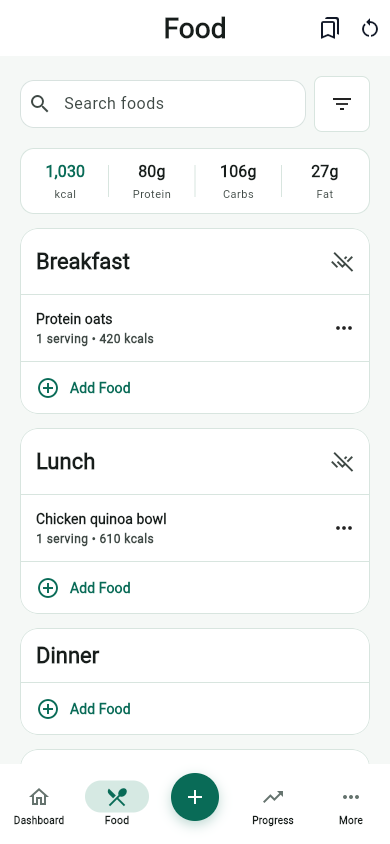
What does the new 2025–2030 Food Pyramid mean for your daily food log? It means the log should help you see the quality, quantity, and consistency of your complete eating pattern—not force every meal to look like a pyramid. Record what you actually eat, verify portions and nutrition data, notice whether protein foods, vegetables, fruits, dairy, healthy fats, and whole grains appear across the day, and review foods high in added sugars, refined carbohydrates, sodium, or saturated fat in context. The federal guidance is a population-level framework; your log is the place where that framework meets your real schedule, preferences, budget, and health needs.
The Dietary Guidelines for Americans, 2025–2030 were released in January 2026 with a new pyramid graphic and the central message to eat real food. In the 2026 IFIC Food & Health Survey, 83% of surveyed U.S. adults said they had seen the new pyramid, while 42% said they knew at least a fair amount about the Dietary Guidelines themselves. That gap matters: recognizing a graphic is not the same as knowing what to do at breakfast, in a grocery aisle, or after a day that did not go as planned.
What changed in the 2025–2030 guidance?
The new presentation places protein, dairy, healthy fats, fruits, and vegetables prominently, with whole grains also represented. It emphasizes whole, nutrient-dense foods and calls for reducing highly processed foods that contribute refined carbohydrates, added sugars, excess sodium, and less-helpful fats. It also retains an important principle that can disappear in social-media summaries: foods and portions still need to fit an appropriate total energy intake.
A pyramid is a communication device, not a diagnostic instrument or a personalized meal plan. It cannot see allergies, culture, food access, training demands, pregnancy, kidney function, diabetes medications, an eating disorder history, or a clinician-prescribed diet. It also does not make one isolated food healthy or unhealthy. Use the graphic to ask better pattern-level questions, then use qualified professional guidance when your medical context changes the answer.
Use three levels of review: meal, day, and week
The strongest way to translate broad dietary guidance into data is to review it at three different time scales. A meal-level view helps you make the next decision. A daily view shows totals and obvious gaps. A weekly view separates a durable pattern from an unusual event. Looking at only one level can mislead: a balanced lunch cannot describe the whole week, while a weekly average can hide that you routinely arrive at dinner extremely hungry.
- Meal level: What foods are present, what portion did you eat, and what useful component—such as protein, produce, whole grains, or satisfying fat—might be missing?
- Day level: How do calories and macronutrients compare with your chosen targets, and where did fiber-rich foods, added sugars, sodium, hydration, or meal timing influence the day?
- Week level: Which choices recur, which meals solve real constraints, and which gaps keep appearing often enough to deserve a plan?
This framework prevents the pyramid from becoming a pass-or-fail test. A restaurant dinner, birthday cake, or packaged lunch can be accurately logged without defining the entire pattern. The value comes from seeing what surrounds that choice, what repeats, and which small change would improve the next similar meal without making the routine harder to sustain.
Step 1: capture the meal before judging it
Start with faithful capture. Use the logging method that offers the best balance of speed and evidence for the food in front of you. Search works well for common foods, a barcode can retrieve a packaged product, a photo can create a quick starting estimate, and manual entry can document a recipe or product that is not available. The method is not the conclusion; it is how the initial record enters the log.
Then correct the record. Confirm the food identity, serving unit, number of servings, and any cooking fats, dressings, sauces, drinks, or toppings that materially change the meal. For packaged foods, compare the entry with the current Nutrition Facts label. The FDA notes that serving size describes what people typically consume, not necessarily a recommended amount. If your portion differs from the label serving, adjust the log rather than treating the printed serving as a prescription.
Step 2: map foods to useful roles, not moral labels
Once the meal is recorded, ask what role each food plays. A protein food may support a satisfying meal. Vegetables and fruits can add fiber, micronutrients, volume, and variety. Whole grains can contribute fiber and carbohydrate for energy. Dairy or fortified alternatives can contribute protein and selected nutrients. Fats can add flavor, energy, and essential fatty acids. A single food may fill more than one role, and a culturally familiar meal may combine the categories rather than arranging them separately.
This is more technically useful than labeling foods clean or bad. Consider a bean-and-rice bowl: beans contribute plant protein, carbohydrate, and fiber; whole-grain rice contributes carbohydrate and fiber; vegetables add variety; avocado contributes fat. The log can represent those overlapping roles even though the meal does not visually resemble the pyramid. The same principle applies to soups, sandwiches, casseroles, smoothies, and mixed dishes.
Step 3: interpret calories and nutrients together
Food groups explain composition, but quantity still matters. Review energy alongside protein, carbohydrates, fat, and other available nutrients instead of optimizing one number in isolation. A higher-protein day is not automatically appropriate if total intake, fiber, hydration, or food variety suffers. Likewise, a calorie target does not reveal whether most meals are satisfying or whether the day depends on repeated restriction followed by evening hunger.
Nutrient targets are references that require context. Federal Daily Values on labels help compare products; they are not automatically your personal requirements. Individual needs vary with age, sex, body size, activity, life stage, health status, and professional recommendations. If you have been given a medical nutrition target—such as a specific limit for sodium, potassium, carbohydrate, or fluid—that individualized instruction takes priority over a general-purpose app view.
Step 4: review highly processed foods with precision
The new guidance gives highly processed foods unusual prominence, but the phrase should lead to inspection rather than panic. Processing covers many different purposes, including safety, preservation, convenience, fortification, and texture. A frozen vegetable, canned bean, yogurt, whole-grain bread, protein powder, sweetened beverage, and packaged dessert are all processed in different ways and have different nutritional profiles.
Use the ingredient list and Nutrition Facts label to identify the decision that actually matters. Check the portion, calories, protein, fiber, added sugars, sodium, and saturated fat when available. Ask what the product replaces and what it makes possible. A packaged meal that prevents a skipped lunch may be useful; it may work even better with fruit or vegetables. A food can be convenient without becoming the nutritional center of every day.
- Do not infer nutrient quality from package length, marketing language, or one ingredient alone.
- Compare similar products using comparable serving amounts, not whichever label has the smaller printed number.
- Count drinks, sauces, spreads, and cooking fats when they are meaningful parts of intake.
- Look for repeated displacement: what nutrient-dense foods rarely fit because another choice appears so often?
- Improve the recurring pattern before trying to eliminate every imperfect item.
Step 5: turn the log into a grocery decision
Logging becomes more valuable when it changes what is available next. If the week shows that breakfast is consistently short on protein, choose one or two realistic breakfast options and add their ingredients to Grocery. If vegetables disappear on busy evenings, keep frozen, canned, or pre-cut options in Pantry. If lunch depends on takeout because there is no planned alternative, save a meal combination that can be assembled quickly and shop for it before the schedule becomes crowded.
This is where guidance becomes behavior. The pyramid identifies broad categories; your data identifies the bottleneck. The next useful action might be buying fruit, preparing a protein option, choosing a whole-grain staple, keeping a convenient meal available, or simply logging portions more accurately. It does not need to be a complete dietary overhaul.
A practical guideline-to-log framework
- Capture: Record the foods, drinks, portions, and important preparation details as accurately as practical.
- Classify: Identify the roles represented in the meal—protein foods, vegetables, fruits, dairy or alternatives, fats, and whole grains—without forcing mixed dishes into one category.
- Contextualize: Review calories, macronutrients, MyFit Score, timing, hydration, and your current goal together.
- Compare: Look across the day and week for recurring strengths, gaps, and foods that are difficult to fit.
- Plan: Use saved meals, Pantry, and Grocery to make the next better choice easier to repeat.
- Escalate: Bring the record to a registered dietitian or other qualified clinician when a medical condition, symptom, medication, pregnancy, or prescribed diet requires individualized advice.
The MyFitLife answer
The new Food Pyramid should make your daily log more useful, not more rigid. MyFitLife lets you capture food through search, photo analysis, barcode scanning, or manual entry; review portions, calories, macros, and available nutrition details; use MyFit Score as context; save meals that work; and connect repeated gaps to Pantry, Grocery, and progress. The answer is a feedback loop: log the real meal, understand its role in the full pattern, plan one practical improvement, and review what happens over time.
MyFitLife is a general wellness tool, not a medical device, diagnostic service, or individualized diet prescription. The 2025–2030 Dietary Guidelines are population guidance. If you have diabetes, kidney disease, food allergies, gastrointestinal disease, pregnancy-related nutrition needs, a history of disordered eating, unexplained weight change, or a clinician-directed diet, use your log to support a conversation with a qualified healthcare professional rather than changing treatment from a pyramid or app score alone.
Sources and further reading
- Dietary Guidelines for Americans, 2025-2030 U.S. Department of Health and Human Services and USDA
- Dietary Guidelines for Americans, 2025-2030 U.S. Department of Health and Human Services and USDA
- 2026 IFIC Food & Health Survey: A Focus on Dietary Guidance & Processed Food International Food Information Council
- How to Understand and Use the Nutrition Facts Label U.S. Food and Drug Administration
- Serving Size on the Nutrition Facts Label U.S. Food and Drug Administration
- FoodData Central U.S. Department of Agriculture
- Nutrient Recommendations and Databases NIH Office of Dietary Supplements
- Weight Management and Healthy Living Tips National Institute of Diabetes and Digestive and Kidney Diseases
- MyFitLife Health Disclaimer MyFitLife
Related articles
- How Can You Eat Healthy and Still Enjoy Food?
- Can You Eat Ultra-Processed Foods and Still Eat Healthy?
- Fibermaxxing Without Breaking Your Macros: What Should You Track?
Install free. Keep the core tracker free.
Log food, scan barcodes, track macros, and review progress without starting a subscription.