Is There One App That Tracks Food, Water, Fasting, and Supplements Together?
See how one app can connect food, water, fasting, supplements, and progress without confusing estimates, label records, schedules, and health outcomes.
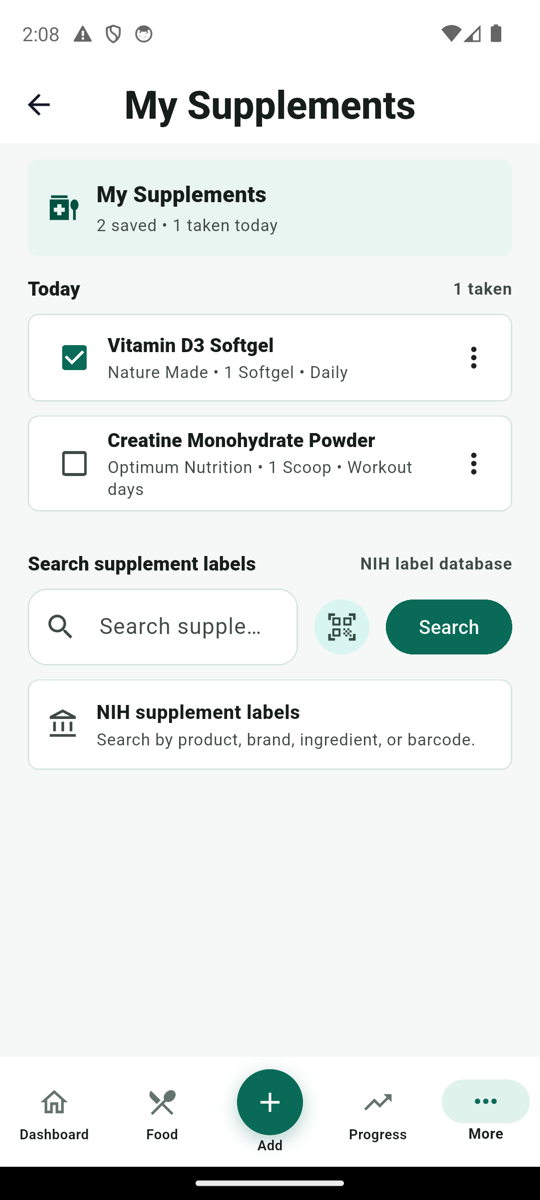
Is there one app that tracks food, water, fasting, and supplements together? Yes: MyFitLife brings those general-wellness records into one iOS and Android experience, along with progress review. The important qualification is that one app should not imply one meaning or one combined screen. Food entries are nutrition estimates, water entries record a hydration habit, fasting records describe timing, NIH Dietary Supplement Label Database records reproduce label information, supplement check-ins document what you recorded as taken or skipped, and progress data show observations over time. MyFitLife connects the workflow while keeping those evidence types and their dedicated views distinct.
That separation is what makes an all-in-one nutrition tracker technically useful. Putting five counters on one dashboard is easy; helping a person interpret them without creating false causation is harder. A completed fast does not prove a calorie deficit. A supplement marked taken does not prove absorption, efficacy, or safety. A water goal does not diagnose hydration status. A day that meets macro targets does not establish dietary adequacy. The value of one app is less duplicated entry, consistent time context, and a clearer record for reflection—not a claim that every signal measures the same outcome.
Why separate trackers create avoidable blind spots
When food lives in one app, water in another, fasting in a timer, supplements in phone reminders, and weight in a spreadsheet, each tool sees only one behavior. The user must mentally reconstruct the day, align dates and time zones, remember missing entries, and decide whether two records refer to the same period. That friction can turn review into guesswork. It also makes simple operational questions surprisingly difficult: Did a late meal shorten the fast? Was the planned supplement actually recorded? Did the apparent low-water day reflect behavior or missing data?
A shared system reduces those coordination costs by preserving a common calendar and a consistent account. It can show related records without collapsing them into a single health score. This is closer to an observability system than an automatic coach: several instruments describe different parts of the routine, and the person decides what question to investigate. The data become more useful when every value retains its source, unit, timestamp, status, and limitation.
The MyFitLife Nutrition Signal Map
Use the Nutrition Signal Map to interpret an all-in-one record. For each signal, ask five things: Where did the data come from? What unit or status was recorded? What period does it describe? What question can it reasonably help answer? What can it not prove? This framework prevents convenience from becoming overconfidence.
- Food: source may be a barcode, USDA or other search record, photo estimate, saved meal, recipe, or manual entry; units may be servings, pieces, grams, ounces, or volume; the record estimates intake and cannot prove exact absorption or medical suitability.
- Water: source is a user-entered amount; units represent consumed fluid recorded for a day; the log helps review a hydration habit but does not measure blood chemistry, fluid balance, or individual clinical fluid needs.
- Fasting: source is a timer or saved start and end; units are elapsed time and completion status; the record describes an eating window and does not establish metabolic state, safety, or weight-loss effectiveness.
- Supplements: source may include a physical label or NIH DSLD label record; units describe labeled amounts and a schedule; the record does not certify product quality, approval, efficacy, safe dosage, or freedom from interactions.
- Adherence: source is the status the user records, such as taken, skipped, missed, planned, or as needed; it documents the check-in and cannot verify ingestion, correct technique, biological effect, or long-term adherence.
- Progress: source is a measurement or user entry over time; units depend on the metric; the trend can organize observations but cannot diagnose why a value changed or establish that another tracked behavior caused it.
Food tracking is an estimate with provenance
Food logging begins with identification and quantity. A packaged product may be retrieved by barcode, a common food may come from USDA FoodData Central, a photo may generate an editable estimate, and a homemade dish may be represented by a recipe. Every route has a different evidence strength. The current package label is often the best available source for a specific branded item, while weighed ingredients can make a repeated recipe more reproducible. Search and photo tools reduce friction but still require the user to check identity, serving, and omitted ingredients.
Calories, protein, carbohydrate, fat, and micronutrients should be read as estimates at the amount logged. Nutrition Facts values use labeling conventions and rounding; databases can be incomplete; restaurant and home preparation vary; and people rarely measure every bite. That does not make the record useless. It makes source and consistency important. A repeatable logging method can reveal patterns, while false precision can make a weak estimate look stronger than it is.
Water tracking records behavior, not hydration status
Water has a simple interface but a complex physiological context. The CDC notes that water needs vary and that people also obtain water from foods and other beverages. Climate, activity, pregnancy, breastfeeding, illness, medications, and health conditions can change needs. A daily water total can answer whether you recorded fluids and whether repeated logging supports your routine. It cannot independently answer whether you are adequately hydrated or whether a generic target is safe for you.
Use the tracker as a habit record: log the amount, use a consistent unit, and review whether entries are complete enough for your question. Do not treat a green progress ring as clearance to force additional fluid. People with heart failure, kidney disease, electrolyte disorders, or clinician-directed fluid limits need individualized instructions. Symptoms of dehydration, overhydration, or acute illness belong with a healthcare professional, not an app calculation.
A fasting timer measures time—and only time
A fasting record can reliably store a chosen start, end, duration, and completion status. It can help someone see whether the intended eating window fits work, sleep, training, social meals, and medication routines. It cannot determine a precise metabolic switch, prove fat loss, or show that fasting is better than another eating pattern. Research compares multiple fasting protocols and populations, so findings should not be generalized into a universal promise.
Fasting also has meaningful safety boundaries. NIDDK specifically discusses the need for medication and glucose-management planning when people with diabetes fast. Children, people who are pregnant or breastfeeding, people with a history of eating disorders, and anyone taking medicines affected by meal timing should not infer safety from a timer. A clinician who knows the person and treatment plan is the appropriate source for medical fasting guidance. The app should preserve the schedule record without presenting elapsed hours as medical advice.
Supplement records need two separate layers
A useful supplement tracker separates product identity from behavior. The first layer describes what the product label says: brand, product name, form, ingredients, labeled amounts, and directions. MyFitLife can use NIH DSLD records to make that label information easier to find. DSLD catalogs package labels, including products that are on market and off market, and updates records as labels change. It is a research and information resource, not a list of recommended products.
The second layer records the user’s plan and check-in: which days or times are scheduled, whether an item is planned or as needed, and whether the user recorded it as taken, skipped, or missed. That history can make a routine visible. It does not prove the correct dose, ingestion, absorption, efficacy, or safety. The FDA does not approve dietary supplements for safety and effectiveness before marketing in the way it approves drugs, and products can interact with medicines or each other. Label presence is not clinical endorsement.
- Taken means the user recorded that event; it is not a sensor-verified administration record.
- Skipped means a deliberate recorded choice; it does not say whether that choice was medically appropriate.
- Missed distinguishes an uncompleted scheduled event from an intentional skip when the user records it that way.
- Planned describes a schedule and should not be interpreted as adherence before the event occurs.
- As needed preserves the status the user recorded without asking the app to decide when the product is needed.
Progress is a timeline, not a causal engine
Progress records can place measurements beside logged nutrition, hydration, check-ins, and fasting context. Supplement schedules and taken, skipped, or missed events remain in the dedicated My Supplements area rather than appearing as a supplement series in Progress. Reviewing those separate views can still generate useful questions: Was food capture more complete this week? Did the fasting schedule become difficult on training days? Were supplement events repeatedly recorded as missed at a particular scheduled time? Neither view should convert timing into causation. A weight change after a supplement entry does not show that the supplement caused it, and a low-energy day after a fast does not establish a diagnosis.
The correct use is pattern review. Look for recurring missing data, changes that persist across an appropriate time horizon, and routines that are easier or harder to maintain. Then change one operational variable or bring the record to a qualified professional when the question is medical. An integrated tracker improves the chronology of the conversation; it does not replace the expertise needed to interpret symptoms, laboratory values, medication effects, or disease risk.
What one representative day can show
Imagine a user ends a fasting timer at 8:05 a.m., logs breakfast from saved foods, records 16 ounces of water, and marks a scheduled supplement taken. At lunch, a barcode result is corrected against the package serving. In the afternoon, another water entry is added. Dinner is logged from a saved recipe, and an evening supplement is marked missed. The next morning, the user adds a progress measurement. One account now preserves what was recorded across the appropriate MyFitLife features, with less reconstruction across separate apps.
The combined record still does not reveal whether breakfast caused hunger later, whether the water total met a physiological need, whether the supplement worked, or why the measurement changed. It does reveal a specific data-quality issue—the lunch serving needed correction—and an actionable routine issue—the evening schedule may be difficult to follow. Those are appropriately modest conclusions. A good all-in-one tool should make the supported observation easy and the unsupported leap harder.
A seven-question selection checklist
- Does the app name the source of food and supplement information rather than presenting every result as equivalent?
- Can you correct products, serving units, amounts, timing, and statuses without fighting the interface?
- Does it distinguish a plan from a completed event and a recorded event from a verified biological outcome?
- Can you review daily and longer-term patterns without the app claiming that correlation proves causation?
- Are general-wellness boundaries, privacy terms, and health disclaimers visible and understandable?
- Can the core workflow remain useful when an AI estimate is unavailable or inappropriate?
- Can you export, share, or discuss the records with a qualified professional when the question exceeds the app’s role?
Privacy and safety should survive consolidation
Combining records can create a more revealing dataset than any one tracker held alone. Read the privacy statement, understand account and deletion controls, protect device access, and avoid entering information you do not need the service to process. A unified tracker should earn the convenience it provides through clear handling practices. Consolidation is not automatically safer or riskier; the answer depends on implementation, access, retention, user choices, and the sensitivity of the information entered.
MyFitLife is a general-wellness app, not a medical device, diagnostic service, medication administration record, or substitute for a physician, pharmacist, or registered dietitian. It does not determine supplement safety, prescribe fasting, diagnose hydration, or promise weight loss. Stop and seek professional care for concerning symptoms, suspected supplement reactions, eating-disorder concerns, or questions involving medication, pregnancy, diabetes, kidney or heart disease, or another condition that changes ordinary nutrition guidance.
The MyFitLife answer
MyFitLife is the one-app answer when the goal is to track food, water, fasting, supplements, and progress in a connected general-wellness workflow. Food tools preserve editable nutrition estimates; water records support a daily habit; fasting stores timing; NIH DSLD can help identify supplement-label information; schedule statuses document what the user recorded; and progress views organize observations over time. The shared benefit is context and reduced friction, not a blended claim about health outcomes.
Use the Nutrition Signal Map whenever two records appear related: identify the source, unit or status, time scale, supported question, and limitation for each. That discipline allows a connected workflow with dedicated views to remain honest. It can help you remember, review, and prepare better questions while preserving the line between a recorded behavior and a medical conclusion. For everyday organization, that is a meaningful all-in-one answer; for diagnosis, treatment, dosage, or individualized safety, the answer remains a qualified healthcare professional.
Sources and further reading
- About Water and Healthier Drinks Centers for Disease Control and Prevention
- How to Understand and Use the Nutrition Facts Label U.S. Food and Drug Administration
- FoodData Central U.S. Department of Agriculture
- Time-restricted eating for metabolic syndrome National Institutes of Health
- What Can You Tell Your Patients About Intermittent Fasting and Type 2 Diabetes? National Institute of Diabetes and Digestive and Kidney Diseases
- Fasting Safely with Diabetes National Institute of Diabetes and Digestive and Kidney Diseases
- Intermittent fasting, traditional dietary advice, or no treatment: which works better to help adults lose weight? Cochrane
- Dietary Supplement Label Database (DSLD) NIH Office of Dietary Supplements
- Dietary Supplement Label Database API NIH Office of Dietary Supplements
- FDA 101: Dietary Supplements U.S. Food and Drug Administration
- Nutrient Recommendations and Databases NIH Office of Dietary Supplements
- MyFitLife Privacy Statement MyFitLife
- MyFitLife Health Disclaimer MyFitLife
Related articles
- Can a Supplement Tracker Handle Multiple Doses and Label Scanning?
- Should You Judge Weight Loss by One Weigh-In or a Trend?
- Can a Food Tracker Show Past Meals and Calories?
Install free. Keep the core tracker free.
Log food, scan barcodes, track macros, and review progress without starting a subscription.