Should You Judge Weight Loss by One Weigh-In or a Trend?
Should you trust one weigh-in or a trend? Learn why weight varies, what self-weighing evidence shows, and how MyFitLife adds useful context.
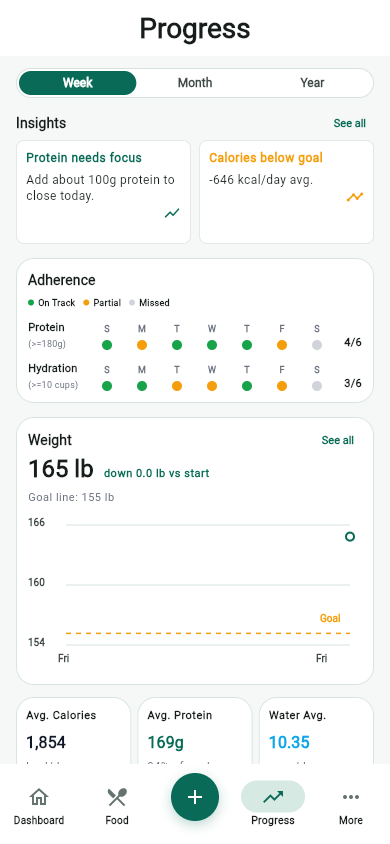
Should you judge weight loss by one weigh-in or a trend? Usually, the trend is more informative. One reading is a measurement, not a verdict or a trend. A scale measures total body mass at one moment, including normal changes in water, food and waste in the digestive tract, clothing, and other short-term influences. One higher or lower value does not establish fat gain, fat loss, success, failure, or a medical problem. A sequence of measurements collected under reasonably consistent conditions provides more context. MyFitLife records the actual weights a user enters and displays those raw points across Week, Month, and Year views; it does not smooth them into a moving average or forecast what comes next.
Why can body weight change from one day to the next?
Body weight is not the same thing as body fat. Water balance can shift with food and fluid intake, sodium, carbohydrate storage, sweating, bowel and bladder contents, medicines, illness, and hormonal changes. The amount of clothing worn, time of day, scale placement, and differences between devices can also change the reading. These influences can temporarily be larger than the gradual tissue change a person is trying to observe.
Research illustrates the scale of ordinary variation. A long standardized record from one healthy adult found a standard deviation of about 0.53% in day-to-day body-mass differences, while a small study of well-hydrated older hospital patients found that time of weighing explained most observed variation and that comparisons made at the same time each day varied less. Another study observed an average increase of roughly 0.5 kilograms during menstruation, largely attributed to extracellular fluid. These studies involve different populations and should not be converted into a universal allowance, but they demonstrate why a single point needs context.
Does daily self-weighing cause weight loss?
The evidence is mixed, and the study design matters. In one randomized trial of 91 adults, an intervention combining a connected scale, a weight graph, weekly tailored email feedback, and lessons produced greater weight loss than delayed control. Because those elements were delivered together, the result does not prove that stepping on a scale alone caused the difference.
A separate randomized trial of 183 adults tested instructions to weigh daily with scales but little effective behavioral support. The difference in weight loss was not statistically significant, and greater weighing frequency was not associated with greater loss. Another two-year trial paired frequent weighing with visual feedback and found a small average benefit, with important variation between participants. Together, these trials suggest that measurement can support self-regulation for some people, but measurement is not the mechanism that changes body tissue and is not a guaranteed intervention.
Observational evidence offers a different kind of signal. A cohort study of almost 10,000 long-term smart-scale users found that more frequent weighing was associated with more favorable weight outcomes and that breaks in weighing were associated with gain. The reported correlations were small, however, and the design cannot establish causation. People who weigh more consistently may also differ in motivation, routines, goals, health status, or other behaviors. Association is useful evidence, but it is not proof that weighing produced the outcome.
Is daily weighing right for everyone?
No. Psychological findings are also mixed. A large young-adult trial of multicomponent self-regulation programs found no evidence of worse depressive symptoms, compensatory behaviors, or health-related quality of life. A smaller two-week randomized study in emerging adult women found greater negative-affect variability, more weight-related stress, and lower body satisfaction after daily weighing than after an active control behavior. Those populations and interventions differ, so neither result should be generalized to every person.
- Daily weighing may be useful when repeated measurements feel emotionally neutral and support a routine without dictating the rest of the day.
- Weekly or less frequent check-ins may be more sustainable when daily values create unnecessary distraction.
- Stop or reduce weighing if it drives anxiety, shame, compulsive checking, food restriction, purging, binge eating, compensatory exercise, or other harmful behavior.
- Anyone with an eating-disorder history, active symptoms, pregnancy, significant fluid-balance concerns, or a clinician-directed monitoring plan should seek individualized guidance rather than follow a generic weighing schedule.
What does a weight trend actually mean?
A weight trend is a time-ordered set of measurements interpreted across an interval. It is not a verdict attached to the final dot. More points can make recurring variation easier to recognize, but the usefulness of the series still depends on measurement consistency, missing data, and the question being asked. Two measurements can show a difference; a longer series can show whether similar differences persist, reverse, or remain irregular.
MyFitLife offers Week, Month, and Year intervals. Week begins with the current Sunday, Month begins on the first day of the current month, and Year begins on January 1. The displayed line uses raw check-in weights from the selected interval. When available, it also includes a baseline from the latest recorded check-in before the interval. If there is no earlier entry but the first interval check-in preserved a meaningful previous weight, that previous value can supply the baseline. Otherwise, the first available interval point becomes the comparison basis.
The change shown for the interval is the current recorded weight minus that baseline. Week labels use days of the week, Month labels use calendar dates, and Year labels use months. MyFitLife does not insert daily estimates between measurements, replace raw points with a smoothed curve, calculate a moving average, predict a future weight, or diagnose the reason for a change. Missing weigh-ins remain missing rather than being silently manufactured.
How do MyFitLife check-ins work?
A Progress check-in records a weight in pounds, a self-reported Energy score from 1 through 10, and optional notes for the current date. The weight is rounded to one decimal place when the backend stores it. Saving a check-in writes the dated weight-history record and updates the current weight in the user profile together, so the profile and newest saved check-in do not intentionally drift apart.
If the current profile weight is changed through another supported profile flow and it differs from the latest history entry, Progress can represent that current profile value as a Today point. That keeps the current weight visible instead of presenting older history as current. It is still a raw supplied value, not an inferred measurement. Entering another check-in for the same date updates that date rather than creating multiple independent daily points.
Energy is a personal 1-to-10 check-in, not a validated clinical scale. Notes can preserve context such as travel, an unusually late measurement, soreness, or a change in routine, but they remain user-entered observations. Neither the score nor a note proves why weight moved, screens for disease, or replaces symptoms and history reviewed by a qualified professional.
How should nutrition and hydration appear beside weight?
Context helps users ask better questions without pretending to answer them automatically. In the selected interval, MyFitLife can display weight alongside logged-day averages for calories, protein, carbohydrates, fat, and water, plus protein and hydration goal-day counts. A day with no food or water entry is labeled No log. It is not treated as a confirmed zero-intake day. Nutrition averages use days that contain logged nutrition or hydration rather than filling every missing date with zero.
That distinction prevents an empty record from masquerading as physiology, but it does not make partial logging complete. A low water total might mean low intake or an unfinished log. A weight change after a salty meal, hard workout, travel day, or menstrual phase may be consistent with a temporary shift, but MyFitLife does not automatically infer that cause. The parallel records are evidence for reflection, not an automated causal model.
How can you collect more comparable measurements?
- Use the same scale when practical, place it on a firm and level surface, and follow the manufacturer instructions.
- Choose a repeatable time. Morning after using the bathroom and before eating or drinking is common, but consistency matters more than copying a schedule that does not fit.
- Keep clothing and carried items similar. A clinic reading later in the day and a lightly clothed home reading are not perfectly interchangeable.
- Stand in the same position and let the scale complete its measurement before recording the value.
- Record the actual reading instead of changing it to match expectations. Add a short note when conditions were meaningfully different.
- Review several points over the selected interval before deciding that a change is persistent. Do not respond to one unexpected number with an extreme restriction or exercise session.
Formal research protocols such as NHANES use trained examiners, standardized positioning, calibrated equipment, and documented procedures because measurement conditions matter. A home routine will not reproduce a research examination, but it can reduce avoidable noise by keeping the device and conditions reasonably consistent.
How often should you record a weight?
There is no single frequency that is best for every user. Daily entries create a denser series and may make normal oscillation more visible, but they also expose the user to more short-term noise. Weekly entries reduce that exposure but can still land on an unusually high or low day. A workable schedule is consistent enough to answer the question, psychologically safe enough to maintain, and compatible with any guidance from the user’s healthcare team.
What can be shared without exposing weight?
MyFitLife has a user-initiated native share action for an aggregate Progress summary. It can include the selected interval and date range, goal-day counts, logged-day averages for calories, protein, and water, completed-fast aggregates when present, and a next-focus line. It excludes raw weight values, weight change, check-in notes, names, account identifiers, and meal-level logs. The device share sheet still lets the user choose a destination, so the user should review that destination before sending.
What should a weight tracker never claim?
- A single increase is not proof of fat gain, and a single decrease is not proof of fat loss.
- A raw weight series is not a diagnosis, body-composition measurement, treatment recommendation, or emergency-monitoring system.
- MyFitLife does not apply smoothing, calculate a moving average, forecast future weight, or automatically infer why a change occurred.
- Nutrition, hydration, energy, and notes can add context, but correlation between those entries and weight does not establish causation.
The MyFitLife answer
MyFitLife answers the one-weigh-in problem by preserving the measurements as a transparent series. Users can record weight in pounds with a 1-to-10 Energy score and optional notes, then examine raw Week, Month, or Year points against a documented interval baseline. The same Progress view provides logged-day nutrition and hydration context while keeping No log distinct from zero.
The result is not a smoothed promise or an automated explanation. It is a more useful record: what was entered, when it was entered, how the interval changed, and which supporting logs exist. Use that record to notice persistent patterns and prepare better questions. Use a qualified healthcare professional for diagnosis, treatment, unexpected rapid changes, fluid-balance concerns, pregnancy-related guidance, or any weighing practice that causes distress.
Sources and further reading
- Day-to-day variability in euvolemic body mass Renal Failure via PubMed Central
- Frequency of Self-Weighing and Weight Change: Cohort Study With 10,000 Smart Scale Users Journal of Medical Internet Research via PubMed Central
- Concordance of in-home smart scale measurement with body weight measured in-person Obesity Science & Practice via PubMed Central
- National Health and Nutrition Examination Survey: 2021 Anthropometry Procedures Manual CDC National Center for Health Statistics
- Short-term body weight fluctuations in older well-hydrated hospitalised patients Journal of Human Nutrition and Dietetics via PubMed
- Changes in body weight and body composition during the menstrual cycle American Journal of Human Biology via PubMed
- Research Behind the Body Weight Planner National Institute of Diabetes and Digestive and Kidney Diseases
- Steps for Losing Weight Centers for Disease Control and Prevention
- Overweight and Obesity Management National Heart, Lung, and Blood Institute
- The efficacy of a daily self-weighing weight loss intervention using smart scales and e-mail Obesity via PubMed
- A randomised controlled trial of the effectiveness of self-weighing as a weight loss intervention International Journal of Behavioral Nutrition and Physical Activity via PubMed
- Frequent Self-Weighing and Visual Feedback for Weight Loss in Overweight Adults Journal of Obesity via PubMed
- Eating pathology and psychological outcomes in young adults in self-regulation interventions using daily self-weighing Health Psychology via PubMed
- Daily self-weighing compared with an active control causes greater negative affective lability in emerging adult women Applied Psychology: Health and Well-Being via PubMed
- MyFitLife Health Disclaimer MyFitLife
Related articles
- Can a Supplement Tracker Handle Multiple Doses and Label Scanning?
- Can a Food Tracker Show Past Meals and Calories?
- Is There One App That Tracks Food, Water, Fasting, and Supplements Together?
Install free. Keep the core tracker free.
Log food, scan barcodes, track macros, and review progress without starting a subscription.